Reading 32 Playing Cards: Structure, Method, and Practice
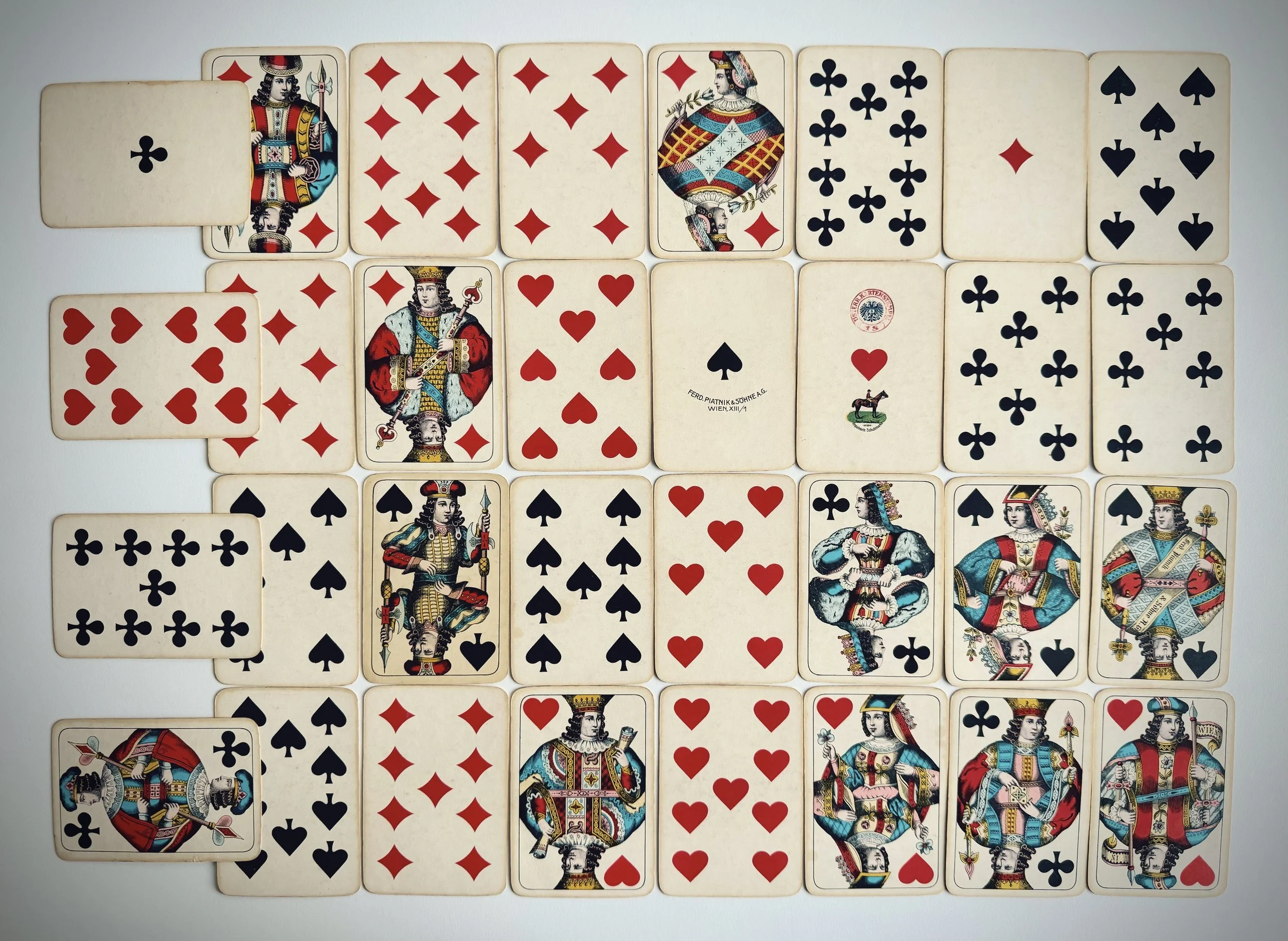
Piatnik Wiener Bild Whist deck, circa 1930. In my private collection.
In a myriad of cartomancy decks and methods — most of which genuinely make me want to throw up yesterday’s dinner — it is oddly relieving to see that classical methods still hold their ground and continue to pique the interest of modern-day cartomancers. In the world of card divination, the playing card deck is the backbone of cartomancy in all its variants. Whether we are speaking of a standard French-suited deck, a Tarot deck (which, let us not forget, was first and foremost a game deck), or the delightfully austere German and Hungarian packs with their bells, acorns, and complete absence of female court cards — playing cards are where it begins and where it ends.
With its four suits, the deck covers the full spectrum of everyday concerns: relationships, home and family affairs (Hearts); financial and intellectual matters (Diamonds); work and daily grind (Clubs); and the inevitable harshness of life (Spades). The numbers mark qualitative intensities within each suit, while the court cards represent recognizable human types. What you have, in other words, is a coherent socio-economic map of daily reality.
Most French-suited decks come in a 52-card format, plus jokers. They are frequently used in cartomancy, with or without those additions. I have, however, made a conscious decision to work exclusively with the 32-card deck. Not only because this reduced form — stemming from the French game of Piquet — is the one I grew up divining with, but because of its economy, its precision, and its remarkable malleability across different reading methods, especially in tableau work.
The numerical reduction does not diminish the experience. It sharpens it. As Camelia Elias has observed in her reflections on the Piquet deck, if 1 is little and 10 is much, then in the reduced system 7 becomes little and 10 becomes much. The spectrum remains intact; it is condensed. Only the Aces shift status. They are no longer treated as the lowest number but as carriers of their suits — structural anchors and symbolic emblems: the Ace of Hearts as the House, Ace of Diamonds as Coin or Letter, Ace of Clubs as stick or foundation, Ace of Spades as Sword or Shovel — cutting, burying, ending.
It has been genuinely encouraging to see this older method gaining traction again. Alongside the Gypsy fortune-telling cards — which remain among the most consulted pieces on this website — the 32-card deck consistently attracts serious interest. Both belong to a time before occult overlays were imposed upon the tarot, before bored elites decided it required metaphysical scaffolding, and before the half-digested psychologization of the 1960s turned card reading into “a mirror of the self” and other such idiocies.
In my work, and in these articles, we will have none of that. We are interested in what works. What holds under pressure. What answers the goddamn question?
What follows is not a reinvention of the deck, nor a personal mythology grafted onto it. It is a structured overview of the 32-card method as I practice and document it — grounded in manual tradition, spatial logic, and observable function. If you want coherence rather than decoration, this is where to begin.
The Structural Backbone: From Piquet to Function
Before touching a spread, one must understand what kind of instrument the 32-card deck actually is.
In From the Piquet Deck to Divination: Functions of the 32 Playing Cards I examine how the reduction from 52 to 32 cards intensifies rather than impoverishes the system. The disappearance of the 2 through 6 does not “remove meaning.” It compresses the numerical field. Each remaining card must carry more weight.
That article lays out how suits function as operational domains, how numbers scale intensity within those domains, and how the Aces assume structural authority. If you want the theory behind the method, start there. Without structural literacy, you are merely reacting to symbols.
Reading by Suits and Rows: Structure in Motion
Once the architecture is understood, the next question is application.
In By Suits and Rows: A General Reading with Playing Cards, I demonstrate how meaning emerges when we stop isolating cards and start observing interaction: suit dominance, horizontal development, vertical tension, clustering, repetition.
This is not about reciting fixed meanings. It is about watching how forces accumulate, contradict, or reinforce each other within space. The article walks through a complete general reading and shows how structure produces clarity.
The Grand Tableau: Ordered Complexity
For those who prefer larger spreads, the 32-card deck lends itself exceptionally well to structured tableaus.
In the Grand Tableau Reading Method from the Serbian Great Folk Dream Book, I present a method derived from the Serbian manual tradition.
This is not decorative mysticism. It is spatial logic applied to lived concerns. If you want to see how the reduced deck handles complexity without collapsing into vagueness, this is the place to study.
Flinging the Cards: Controlled Distribution
Traditional Interpretations: The Serbian Manual Tradition
In Flinging the Cards: Playing Card Divination According to the Serbian Big Folk Dream Book, I present the traditional playing card interpretations as preserved in the Serbian Big Folk Dream Book.
This article is not about layout technique. It is about meaning. Card by card, suit by suit, it outlines how the 32-card deck was historically understood within the folk manual tradition.
The emphasis is on established semantic values: what each card signifies, how suits operate within everyday life, and how combinations were traditionally interpreted. If you want to see the inherited interpretive language of the 32-card deck in its older form, this is the place to begin.
How to Navigate the Method
If you are new to the 32-card deck, begin with the theoretical foundation.
If you want to see structure applied in practice, move to the reading by suits and rows.
If you are ready for full-scale tableau work, study the Grand Tableau method.
If you are curious about regional manual techniques, read about flinging the cards.
Each article addresses a different dimension of the same instrument. Together, they form a coherent method rather than a collection of tricks.
The 32-card deck does not require metaphysical inflation, psychological projection, or symbolic acrobatics. It requires attention to structure, respect for function, and the discipline to follow the logic of the spread.
And when you do, it answers.
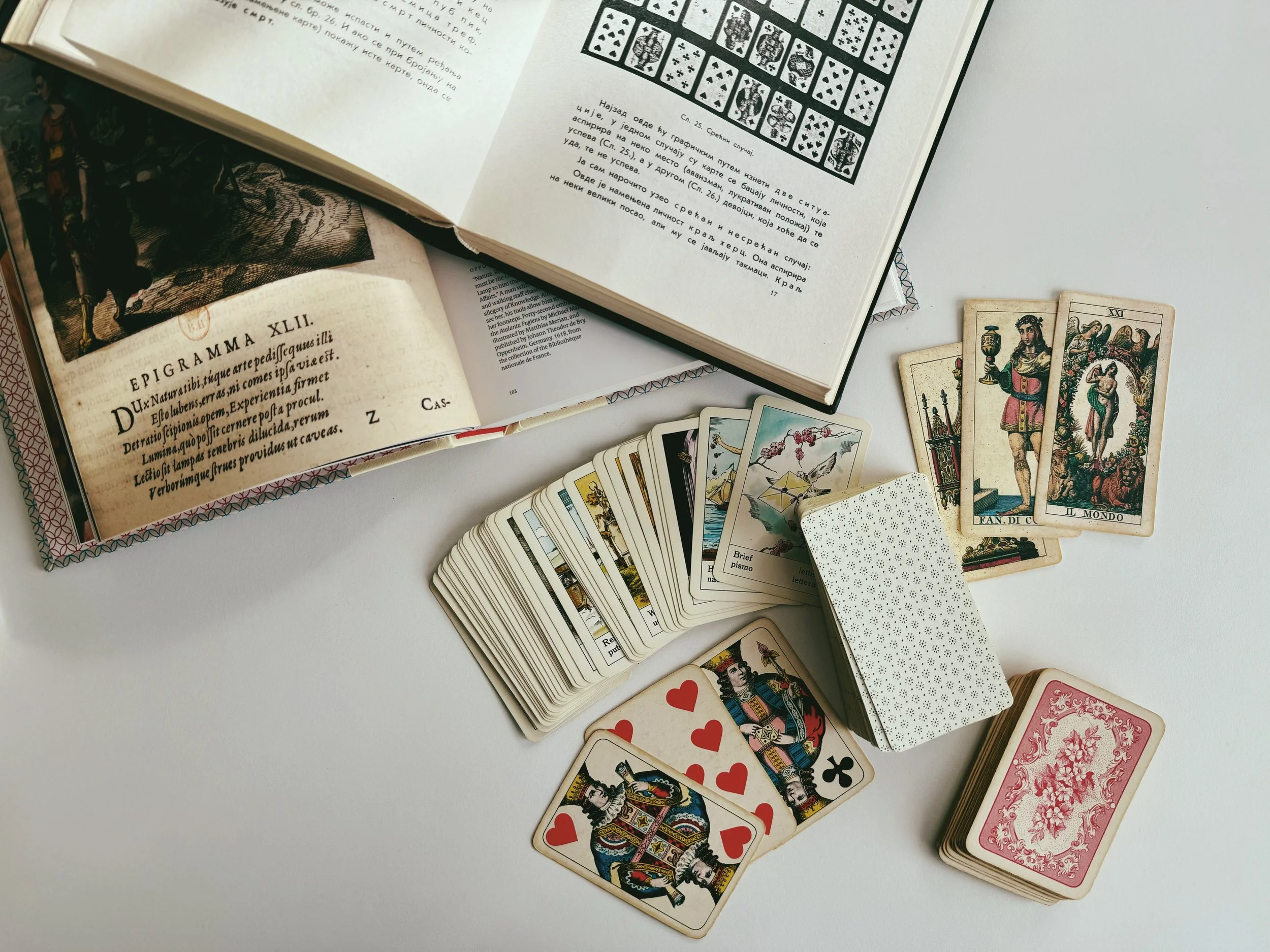
Interested in a lecture on Playing Cards?
Lectures
Faithful blog readers have spoken! A written course on reading the 32-card deck is live! For more information and the registration link, can be found on the Lectures page.
Support the Free Blog
This blog will always remain free. If you find value in the writing and want to help me sustain the time and research that go into each article, you can make a contribution of your choice. It keeps the work independent, ad-free, and focused on substance rather than volume.