Reading the Gypsy Fortune-Telling Cards with Precision
I am often asked how one can read the cards proficiently if the aim is precision rather than parroted interpretation. Every fortuneteller develops their own way of achieving this, myself included. But for the sake of the argument, instead of theorizing about method, why not ask the cards themselves?
I asked a simple question: What is needed to proficiently read the Gypsy Fortune-Telling Cards?
I pulled three cards: Unexpected Joy, Marriage, and Anger.
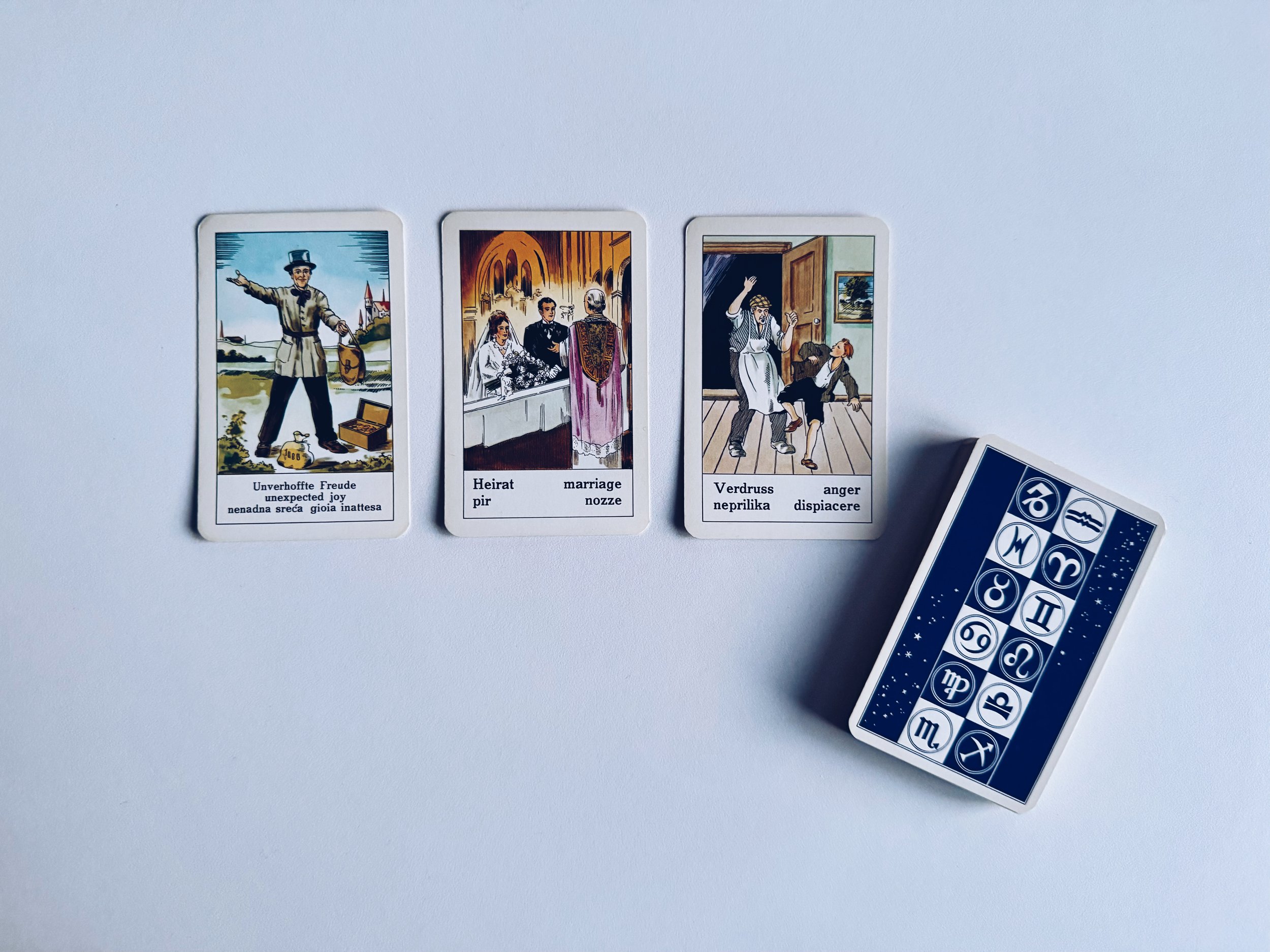
At first glance, this does not look like a list of skills. And that is precisely the point.
Unexpected Joy shows a young man arriving at a crossroads with treasure. The card does not describe effort or mastery; it describes recognition. Something valuable appears when one is correctly oriented. Proficiency, here, is not accumulation of meanings, but the ability to notice where the reading actually converges—where something is being delivered.
Marriage follows, and it immediately formalizes what precedes it. This is not an image of affection, but of binding under supervision. The card introduces structure, commitment, and constraint. Reading the cards well requires submission to form: to layouts, to relational logic, to rules that prevent interpretive drift.
Anger completes the sequence, and it is crucial that it does. The image is hierarchical and disciplinary: a father and son, or a master and apprentice. This is not gratuitous aggression. It shows correction, friction, and the cost of getting it wrong. Proficiency is shaped through tension, not comfort.
Taken together, the answer is straightforward. To read these cards well, one must learn to locate the treasure not in individual cards, but in their relationships. Where do the cards bind? Where do they resist one another? Where is something formalized, and where is it contested?
In other words, proficiency lies in reading dynamics, not meanings. The cards already show us where joinment occurs and where conflict is introduced. Our task is simply to pay attention.
This is also why this deck does not reward decorative interpretation. The images already do the work of narrowing. The title names roles; the scenes specify how those roles operate. What remains is to observe the points of tension—where X actually marks the spot.
This is precisely what I will be covering in my live lecture in seven days, on January 24, where I will be working through my functional analysis approach to reading the Gypsy Fortune-Telling Cards. If you want to read these cards with precision rather than accumulation, you can join me by registering via the link below.
Support the Free Blog
This blog will always remain free. If you find value in the writing and want to help me sustain the time and research that go into each article, you can make a contribution of your choice. It keeps the work independent, ad-free, and focused on substance rather than volume.