Reading Gypsy Fortunetelling Cards - From ‘Meanings’ to Common Sense
Before We Begin
If you’re new to these cards and want to actually read them — not just memorize definitions — follow the steps below:
Learn what these cards point to (function & context): this article - An orientation to Gypsy Fortunetelling Cards that reframes “meanings” as practical functions, showing how cards point to situations, people, and circumstances without relying on fixed or mystical definitions.
See them in action: tableau method - A practical guide to reading Gypsy Fortunetelling Cards in a tableau spread, demonstrating how meaning arises from layout, direction, and interaction between cards, rather than from fixed definitions.
Practice scenario readings: business reading - A concrete example of a Gypsy Fortunetelling Card reading applied to a real-life business question, showing how cards are weighed, combined, and judged in context rather than interpreted one by one.
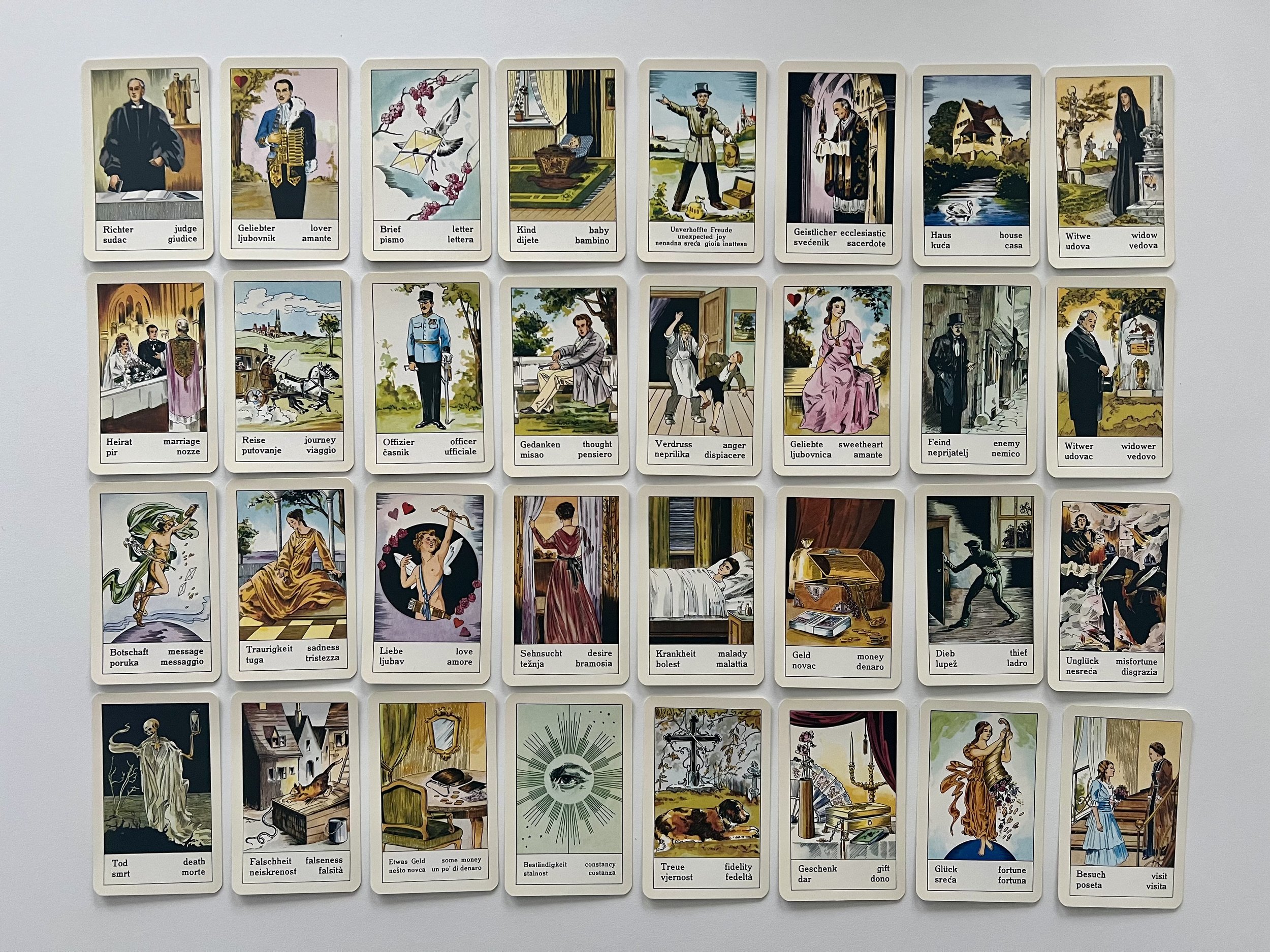
Piatnik’s 1960s edition of Gypsy Fortunetelling Cards. From my private collection.
Introduction
Ever since I started this blog, I never anticipated that writing about Gypsy Fortunetelling Cards would draw significant attention. Yet, I find myself both surprised and proud to share that the most-read article of 2024 on my website is “Keeping a Relationship: A Gypsy Fortunetelling Cards Reading”—by a considerable margin. Considering that this deck was Central Europe’s “best-kept secret” for more than 150 years, you might understand why I initially thought it would remain a local or niche interest. Then again, we’ve seen the same trajectory with the Lenormand deck, which has gradually transcended its German, Belgian, and Dutch origins to gain widespread global recognition.
So, let us have a little context recap:
Piatnik’s Gypsy Fortunetelling Cards boast a rich and diverse history of practical use across Europe. Their origins trace back to the 19th-century Austro-Hungarian Empire, where they first appeared alongside similar oracle decks under the name "Aufschlagkarten," typically comprising 32 cards. This coincided with the popularity of the reduced Piquet deck of 32 playing cards, widely used for divination in Central Europe. Pitanik later expanded this deck to 36 cards. However, unlike Lenormand decks, which incorporated small playing card insets for symbolic references, the Gypsy Fortunetelling Cards are unnumbered and do not reference other fortune-telling systems, standing entirely on their own.
Similar to the Lenormand deck, these cards reflect the concerns of 19th-century bourgeois society: marriage, domestic matters, financial success, and social standing. In the 20th century, Piatnik updated the deck’s visual style and expanded it with four additional cards: Love, Some Money, Loss, and Sadness. The deck’s popularity spread widely throughout the Austro-Hungarian Empire, securing its enduring legacy in the former territories of Serbia, Croatia, Hungary, Romania, Austria, and Germany. Today, it remains an inseparable part of the region’s fortune-telling culture.
The cards themselves represent clear and easily understood concepts: love, friendship, enmity, loss, and success. Yet, there are always those who insist on “hidden” meanings, often claiming that these interpretations were handed down by a great-grandmother or a mysterious teacher. While such stories add a certain charm, I do not subscribe to the idea of secret transmissions. Instead, I believe there is nothing wrong with acknowledging the obvious and focusing on what is visually evident on the table.
I may repeat myself here, but perhaps these “hidden meanings” were useful to your grandmother or mentor in their time and context, but what relevance do they hold for you here and now? Every reading is rooted in the present moment, and what matters most is the ability to interpret what you see, not what others might have imagined or passed down. With this in mind, let us shift our focus to the "meanings" of the cards—not as static definitions but as dynamic tools shaped by context and common sense.
Card Functions - Transcending The List of Meanings
Jump to: Person Significators · Personified Roles and Forces · Everyday Matters · Relational Matters · Material Matters · Fated Matters
As interest in the reading techniques of Gypsy Fortunetelling Cards continues to grow, I wanted to share some interpretations that can serve as a starting point for others. Rather than offering rigid rules or definitive meanings, I aim to provide practical insights that can help readers develop their own understanding of the cards.
The order in which I present the cards is entirely arbitrary, as these cards were never numbered. For clarity and structure, I’ll begin with those that serve as person significators before moving on to those representing everyday matters.
These interpretations are not guided by any fixed canon but are instead rooted in acknowledging the obvious, the plausible, and the probable. By focusing on what is visually apparent and culturally relevant, my hope is to inspire others to approach the cards with clear eyes and common sense, allowing the messages to reveal themselves naturally.
Person Significators
Lover: Male significator, representing an adult man or the querent’s male partner.
Sweetheart: Female significator, representing an adult woman or the querent’s female partner.
Widower: An older man, often a father, grandfather, or older male relative; also represents a literal widower.
Widow: An older woman, often a mother, grandmother, or older female relative; also represents a literal widow.
Child: Represents an infant or the querent’s child. It may also symbolize something small, new, or in its developmental stages.
Officer: An official or man in uniform, such as a doctor, specialist, soldier, police officer, or other professional. It may also symbolize “the other man.”
Personified Roles and Forces
Enemy: An antagonist, either a person or a situation opposing the querent. It can also represent a criminal, conspirator, or "a man in the shadows."
Priest: A man of the cloth, religious official, counselor, magician, or someone of unwavering faith.
Thief: Represents a literal thief, someone who steals goods, ideas, happiness, or opportunities. It may also indicate an unexpected loss, an intrusion, or a malevolent spirit.
Judge: A judgment, decision, or literal judge; may also represent a professor, teacher, or high-ranking official.
Thought: Represents thought, concern, or mental preoccupation; may also appear as a solitary or withdrawn man, particularly in matters of study or worry.
Unexpected Joy: A surprising windfall, luck, or a benevolent young man; may also symbolize a helpful spirit.
Desire: A woman gazing through a window, representing expectation, projection, wishful thinking, daydreaming, or secret admiration.
Sadness: A lonely woman, depression, or despair.
Fortune: Represents happiness, abundance, the Goddess Fortuna, or a young woman in her prime.
Hope: Stability, anchoring, and hope; may also represent a proud woman or someone grounded and practical.
Everyday Matters
Journey: Travel, movement, transportation, or a man in a car; signifies a trip or journey.
Message: A messenger, tutelary spirit, or God Hermes; also represents communication, written or electronic.
Merriment: Dancing, a date, a party, a happy occasion, or a first meeting.
Visit: A visit or meeting, whether private or professional; may also signify an interview, two women, or extended family.
House: A home, place of residence, building, or haven.
Letter: Written information, official correspondence, documents, papers, or tests.
Loss: A chance game, financial loss, a board game, a card game, a hangout, or a lost bet.
Relational Matters
Love: Love, Cupid’s arrow, infatuation, or an angel.
Fidelity: A dog, pet, guardian, faithfulness, or patiently waiting.
Anger: Conflict, a fight, abuse, tyranny, or an attack where the bigger overwhelms the smaller.
Marriage: A relationship, union, wedding, or coming together with a blessing by a third party.
Jealousy: A love triangle, voyeurism, secret admirer, stalker, mistress, or someone disapproving of a relationship.
Falseness: A sudden attack, a snake’s bite, or an untrustworthy person; may also symbolize a cat, snake, or pet cat.
Material Matters
Money: Financial means, wealth, material goods, valuable objects, or a chest.
Some Money: Small financial means, pocket money, bad financial situation, meager funds, or dealing with bills or taxes.
Gift: A present, a gesture of appreciation, pretty objects, aesthetics, jewelry, or a kind gesture.
Fated Matters
Death: An ending, the death of someone or something, or the spirit of a deceased person.
Malady: Illness, a sickbed, rest, or sleep.
Misfortune: An accident, fire, car crash, war, or lifesaving efforts.
Constancy: The all-seeing eye, divinity, divine intervention, transcendence, vision, observation, or being watched.
Conclusion
The meanings presented here are not convoluted interpretations or hidden codes, but straightforward observations grounded in cultural competence and common sense. They reflect what is probable and visible, based on what the imagery and context already suggest. No meaning—whether drawn from tradition, guidebooks, or personal anecdotes—should override what your own eyes can clearly see on the table.
This list is not meant to function as a canon, but as a point of orientation. Its purpose is not to be followed blindly, but to encourage direct observation and sound judgment. The cards do not require interpretation to be inflated; they require attention. What ultimately gives a reading its strength is your ability to relate what is laid out on the table to the querent’s actual situation.
Support the Free Blog
This blog will always remain free. If you find value in the writing and want to help me sustain the time and research that go into each article, you can make a contribution of your choice. It keeps the work independent, ad-free, and focused on substance rather than volume.
Book a Reading
A one-to-one session shaped by your question and the clarity you seek. This is not a performance, but a focused exchange: direct, attentive, and anchored in the cards.
I draw from Tarot, playing cards, Lenormand, or Piatnik’s Gypsy Fortune-Telling Cards depending on what the situation calls for. The structure of the reading adapts to the question—what matters is not the system, but what reveals the clearest path forward.
The session lasts 60 minutes and takes place via Zoom. If you are based in Rotterdam or nearby, an in-person appointment may be arranged upon request.
A video recording of the session will be available
In-person available by request (Rotterdam region)
Limited availability – by appointment only
If you prefer direct, situational readings rooted in traditional methods rather than scripted symbolism, you can schedule a private session here.