
The Known Devil vs. the Open Door: A Reading On a Career Choice
Many of us are bound to the familiar. In evolutionary terms, this is a healthy pattern: staying with what feels safe and predictable reduces existential dread. Our home, our hometown, our family and friends — these are environments we know intimately. We know what to expect, and we can let the wheel of life turn without fearing every bump. But what about our jobs and careers?
In the context of neoliberal capitalism, hyper-flexibility, and a constantly shifting labor market, speaking of predictability — let alone safety — borders on delusion. Ever since the shift to a post-Fordist economy, diversification, instability, and the demand for perpetual adaptiveness have become both economic and cultural imperatives. Expecting any form of solid ground within this system is considered short-sighted at best. The architects of this late-20th-century project — Thatcher and Reagan — tirelessly insisted that we must abandon social and economic safety nets for the sake of “growth.” Mind you, not our growth, but the growth of shareholders’ portfolios. And to that end, let me not miss the opportunity to express my sincere hope that both of their souls are painfully rotting for all eternity. But I digress.
Regardless of our personal stance on the socio-economic order, the fact remains: we are trapped in it unless we decide to retreat into the mountains, reject civilization, and reinvent ourselves as barter-based forest hermits. But even with our predicament laid bare, we continue to crave stability and predictability. At the risk of sounding like a broken record, I will once again invoke Zygmunt Bauman: for human beings, the unpredictability of choice is perpetually agonizing. The more open-ended the possibilities, the greater the agony. This is, of course, a fundamental engine of anxiety. So whenever we are offered even the illusion of safety and predictability, we cling to it — often long past the point of reason. The trouble is that stable routine and goodness do not always overlap. Addictions come to mind, naturally, but so does a supposedly “secure” career.
A client recently found himself in precisely this bind. He has a permanent contract with his current employer; however, the work has become soul-crushingly dull, and he feels no connection whatsoever to his colleagues. By his own account, he performs well and could continue indefinitely, but with a steadily growing resentment toward both the projects and the people around him. Then came an opportunity for a far more engaging role within a respected institution — but with a temporary contract and no promise of permanence.
He wanted to know which path would be better in the long run: the stable, permanent position he now despises, or the uncertain but potentially revitalizing new role? For this, I cast a Choice spread with Lenormand cards.

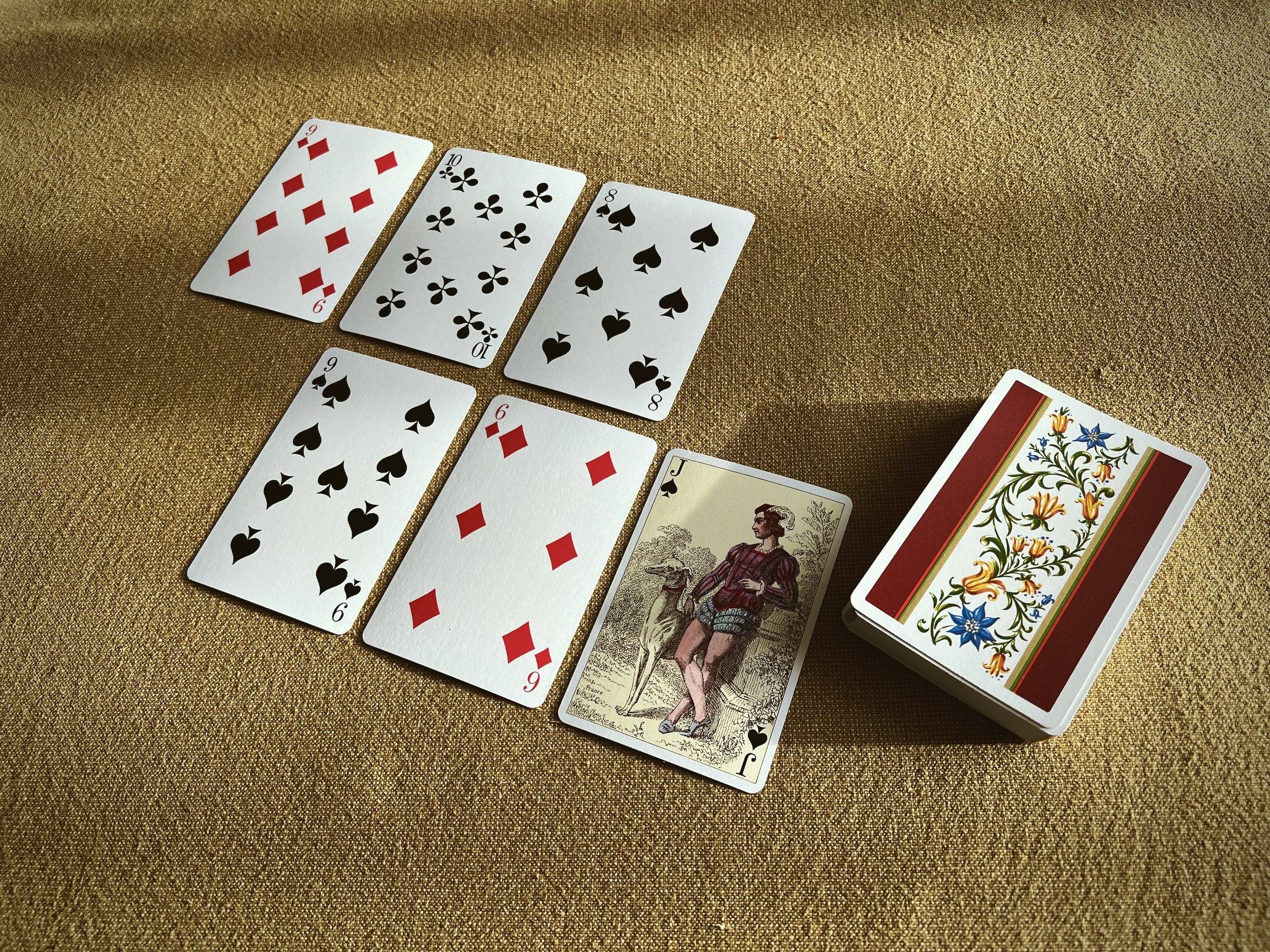
Leipzig Lenormand, Verlag für die Frau, 1982. In my private collection.
The first row concerns his current employment, and the second row the new opportunity. What immediately stands out is the bottom card of the cut deck: the matter of the querent’s heart. And his heart, frankly, is done. The current job may have seemed pleasant enough at the start (Bouquet), but it quickly devolved into a long and tedious slog populated by difficult people (Ship, with the Queen of Spades lurking in the Bouquet, and the Ten of Spades glaring from the Ship). Much like a stork sensing the first bite of winter, he is ready to depart for more agreeable lands. He may return one day — storks do that — but not now.
By contrast, the new workplace reads as a genuine homecoming (King of Hearts atop the House). He may need to familiarize himself with new routines, especially those tied to junior staff structures (Whip, with the Jack of Clubs inset), but the environment itself looks far more congenial, with an evidently friendly circle (Dog and the Ten of Hearts — a striking contrast to the Ten of Spades haunting the Ship). And, of course, we cannot ignore where the Heart card landed — entirely unintentionally — aligned with the second row.
The conclusion writes itself: the new employment is the more promising path, if for nothing else than the quality of the environment. And given that we are not speaking of some junior hire but of a respected, seasoned professional, the specter of an uncertain contract should not frighten us overmuch.
Therefore, when confronted with an agonizing choice, there is nothing left but to capitulate to the cliché — however threadbare it may be — and follow the heart.
Support the Free Blog
This blog will always remain free. If you find value in the writing and want to help me sustain the time and research that go into each article, you can make a contribution of your choice. It keeps the work independent, ad-free, and focused on substance rather than volume.
Book a Focused Reading
If you are facing a difficult decision and want clarity grounded in function, structure, and common sense, you can book a Focused Reading. It includes Choice readings like the one discussed here — direct, context-specific, and without ornamental symbolism. When the stakes are real, the cards should be read accordingly.
A concise, targeted reading for a clearly defined question. This format is best suited for matters that are limited in scope—specific decisions, developments, or encounters that do not require broader contextual analysis.
The reading uses 5 to 6 cards and is typically presented in one of three structured formats, depending on the nature of your question:
Line Reading: A 3-card line provides a concise response to your question, with two additional cards for enhanced clarity. Suitable for a wide range of queries.
Do and Don’t Reading: Three cards explore your situation, while two advise on actions to take or avoid. This format highlights underlying influences and suggests the most constructive course forward.
Choice Reading: Two rows of three cards each represent distinct options or directions. Ideal for those facing a choice that requires clear discernment.
Other variations may be used where appropriate, but these three structures address most focused questions with precision and clarity.
You may specify your preferred deck—Tarot, playing cards, Lenormand oracle, or Piatnik’s Gypsy Fortunetelling cards—or I can select the one most appropriate to your question.
To ensure a focused answer, please provide a clear, concise question along with any relevant context.
Delivered as a written report (600 to 800 words) within 5 business days
Includes a photograph of the spread and a step-by-step explanation
Follow-up clarification available, if needed.