
Balkan Favomancy: Conjuring the Beans to Speak
For anyone who grew up in the former Yugoslavia—particularly in Serbia, Bosnia, Croatia, and Montenegro—phrases such as “Treba li sad da gledam u pasulj/grah da vidim hoće li doći?” (“Do I need to divine the beans now to see whether he’ll come?”) are immediately recognizable. This sarcastic folk expression, used to convey irritation at someone’s unpredictability, is more than just a figure of speech. It is a linguistic trace of a once-widespread practice of folk divination. Although the practice itself is no longer common, its imprint remains clearly visible in everyday language. That said, bean divination is not entirely gone—it survives, quietly but persistently, in several pockets of the Balkans.
Favomancy, or divination with beans, is still practiced in Bosnia, primarily by women known as faladžinice, or bean-readers. The term derives from the Persian fāl, meaning an omen or act of divination. Of all Balkan variants, the Bosnian method of “throwing the beans” is the best documented today, largely because it remains part of a living practice. Another group that has preserved a closely related method—though now on the brink of extinction—are the Vlasi (Vlachs), a Valachian-speaking ethnic minority in Eastern Serbia. In their case, dried corn kernels are often used instead of beans, but the overall logic of the method remains similar, with a few notable differences in layout and interpretation. Among ethnic Serbs in Serbia, the practice appears far more fragmented, though video ethnographies still document elderly women in parts of central and southeastern Serbia performing readings that closely resemble the Vlach method.
Despite its strong presence in language, memory, and living practice, there are no credible academic sources that allow us to trace the Balkan methods of favomancy to a single point of origin or a clearly defined historical lineage. Beyond the practices that are still attested today—most notably in Bosnia and among the Vlach communities of Eastern Serbia—claims of greater antiquity or uninterrupted transmission remain speculative. What can be stated with some confidence is that the Bosnian form developed within an Islamic cultural framework, as evidenced by its terminology and ritual language, while the Serbian and Vlach variants preserve a pre-Christian cosmological structure. Anything beyond this rests not on documentation, but on retrospective interpretation and modern storytelling rather than verifiable ethnographic or historical evidence.
My own introduction to bean reading came through a friend of my aunt—a lovely Teta (auntie) Ružica from the Bosnian town of Tuzla—when I was a teenager in my hometown in Serbia. Until then, beans existed for me only as a proverbial and vaguely mystical reference. That changed the moment Teta Ružica explained the mechanics of the reading. What had been abstract suddenly became concrete. I was immediately hooked. Everyone around me was well-versed in reading coffee grounds, but I was always a gay hipster child, drawn to whatever was less common, more demanding, and a bit out of step. Bean divination fit that bill perfectly. I began practicing it alongside cartomancy, mostly for predictive purposes, as the structure of the spread lends itself particularly well to that end.
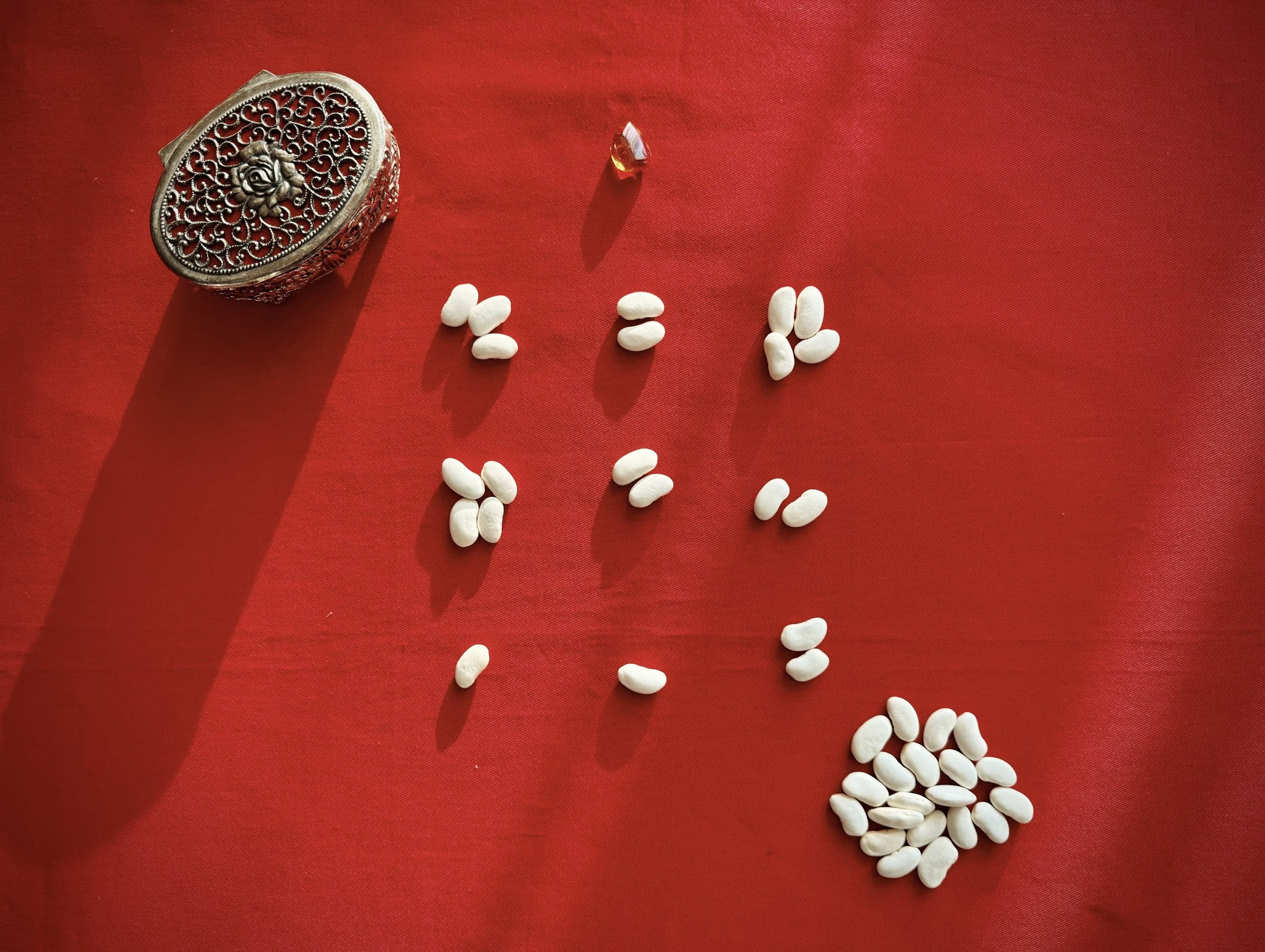
As I briefly outlined in a previous article featuring a predictive reading for a couple trying to conceive, the mechanics of the spread are relatively straightforward. The first row represents the head—what is on the querent’s mind. The second row corresponds to the heart, reflecting feelings and emotional states. The third row represents the feet or the doorstep: what the querent stands on, and what lies just outside the door. The left column traditionally represents the female party, the right column the male party, while the central column signifies either the household or the relationship itself.
Alongside rows and columns, the number of beans in each pile carries its own weight. This system is not symbolic in a modern sense, but practical and proportional. A single bean indicates something minimal, weak, or barely present; two suggest instability or something in movement; three point to growth, movement, or development; and four mark fullness, completion, or an excess that has reached its limit. In other words, one is little, four is a lot. The reading unfolds by observing how these quantities distribute themselves across the layout, showing where something lacks substance, where it is taking shape, and where it has already grown beyond control.
What truly sets this method apart from many other divinatory practices, however, is its explicitly animistic and operative character. The beans are not treated as inert objects but must first be addressed—conjured, if you will—so that they may respond. This is done through an incantation spoken before the casting. Both the Bosnian and the Serbian/Vlach methods employ such an incantation, though their content and cosmological framing differ significantly. In the Bosnian Muslim context, the incantation addresses the beans through an Islamic framework, often invoking elements such as “Fatima’s fāl.” The Serbian and Vlach variants, by contrast, are pre-Christian in structure and language. Here, the beans are addressed as spirits of nature, embedded within a shared human–plant world.
A typical example runs as follows:
“Forty-one grains, forty-one brothers and sisters.
As you knew how to sprout, to grow, and to feed the whole world,
so tell me of the illness / marriage / fate of… (name).
Come out on the forehead with nine grains,
in the middle with two,
on the left and right with three each for growth,
and on the threshold with three and one.
And if it does not bode well,
then scatter yourselves as one and two,
so that nothing comes of it.”
Here, the capacity to reveal the answer is explicitly placed in the beans themselves. They are no longer mere tools, but beings endowed with agency. Their authority derives from their fundamental functions: to germinate, multiply, and sustain human life. If they are capable of such essential acts, the logic follows, they are also capable of traversing the unseen world in search of information relevant to the querent. We are clearly dealing with a chthonic model. Agricultural fertility and the fruits of the earth belong to the chthonic realm; the beans, as products of the soil, are thus aligned with chthonic forces. In this worldview, they stand closer to the spirits that govern human fate and are therefore better positioned to obtain knowledge from that same subterranean domain.
This understanding of beans as agents rather than symbols also shapes how I work with this method today. Bean divination is most effective when it is given a specific, concrete question, because only then does the exchange between querent and these embodied forces become meaningful and informative. It is for precisely this reason that I open favomancy readings to others—not as a novelty, but as a working practice, grounded in the same logic that has sustained it in the Balkans for generations.
You can request a traditional 41-bean reading through my favomancy offering, where a single cast of beans is arranged into the classic three-row structure to illuminate the state of your question and its likely development. Readings are conducted in the spirit of the tradition, with care and attention to the specifics of what you want to inquire about. To request a reading, simply submit your precise question through the form on the Favomancy page, and I will provide you with a written interpretation and a photograph of the cast, delivered as a PDF.
There is no fixed fee for this reading. In keeping with the custom, payment is left to the querent, who may leave an offering for the work according to their own judgment. This is not a gesture meant to “unlock” the reading, but part of the exchange itself, acknowledging the labor of the diviner and the practice that sustains it.
May your path be uncrossed.
Nebojša
Support the Free Blog
This blog will always remain free. If you find value in the writing and want to help me sustain the time and research that go into each article, you can make a contribution of your choice. It keeps the work independent, ad-free, and focused on substance rather than volume.