How Do We Achieve Precision in Reading the 32 Playing Cards?
People often ask me what lends precision to the reading. My answer to this follows only the greatest minds in the field of divination and tends to be short and to the point: we achieve precision by acknowledging the obvious. And this holds for all cartomantic systems, even when your mentors do not tell you so. My own old mentors taught me the corpus of meanings, and of course, it never lent itself to a meaningful reading — the flexibility was in short supply. And yet when I observed them perform readings, they were jumping far off their "canon", which made me rather confused. Confronted with it, they never really gave a clarifying answer either, which only added to the agony. But what I learned in the course of my cartomancy career, and with the help of a wonderful teacher and friend, Camelia Elias, is that the meaning lists are only useful to a certain point, and that true precision arises from being present and acknowledging what is truly there. Ultimately, one of the most precious lessons that I can pass on to my own students is that the cards themselves can provide you with all the clarity you need. So, in continuing this wonderful mentorship tradition, and in the context of my first written course on The Uncrossed Path website, I asked the cards how we can achieve more precision in reading with the 32 playing cards.
The layout I used is simple and effective for this kind of question. Three cards across for the situation, one card above for the DO, and one card below for the DON'T. I also noted the card at the bottom of the cut deck, as it often speaks to the underlying condition or the stance the reading demands. The question was directed not just at myself, but at you — my students and followers — because precision is something we are all working toward, together.
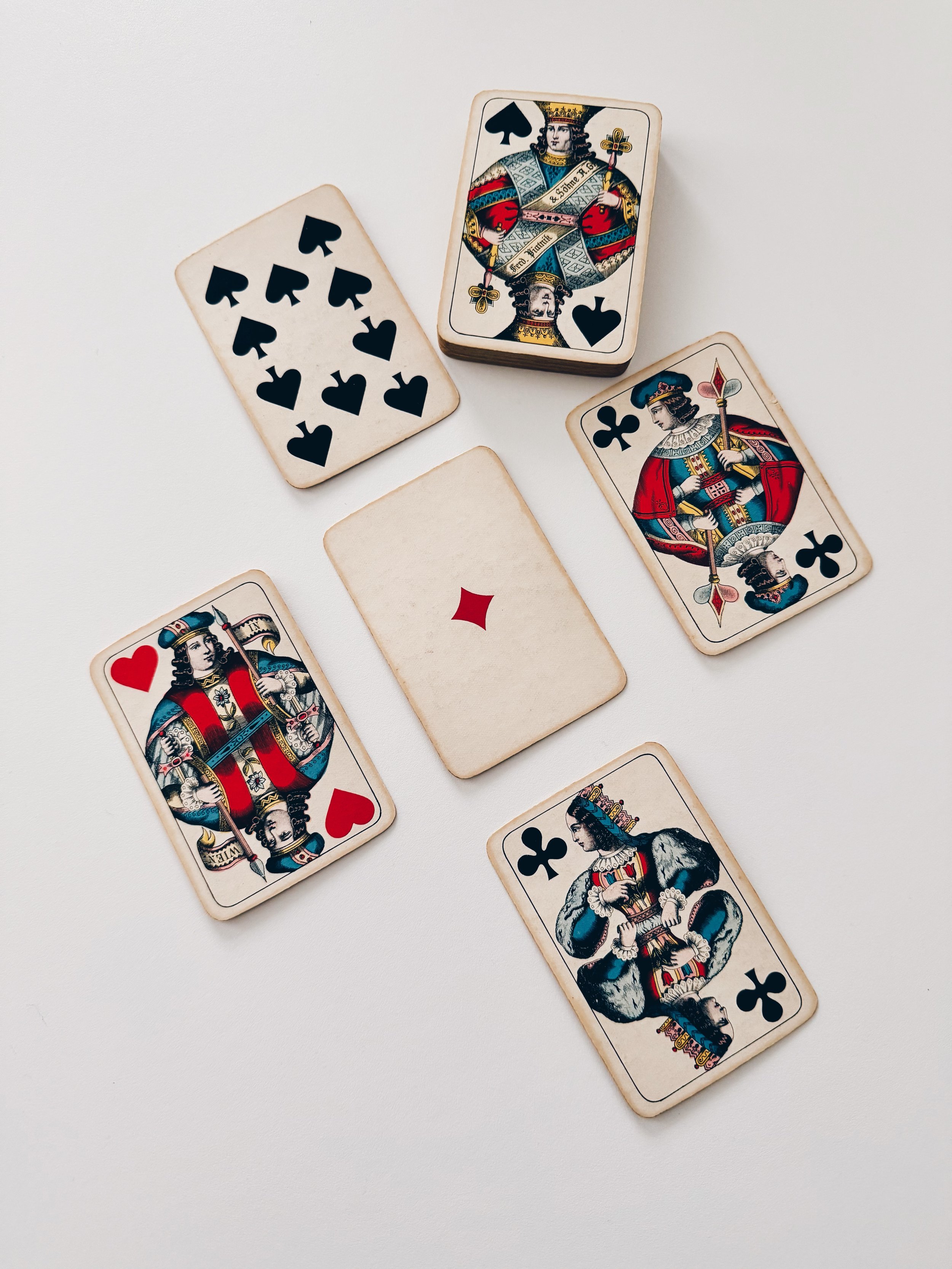
Piatnik’s Wiener Bild Whist deck, ca. 1930. In my private collection.
The Situation: J♥, A♦, J♣
The three cards across gave me J♥, A♦, and J♣, and the picture they form together is immediately legible. Two Jacks flank a single Ace, and both of them are looking at it. The Ace of Diamonds is the message — it is what is being sought, the answer, the signal. The Jacks are the ones doing the seeking, and they are doing it differently.
The Jack of Hearts is led by feeling. He approaches the message through intuition, through what resonates emotionally, through the pull of the heart toward meaning. The Jack of Clubs is led by knowledge. He comes to the message through what he has learned, what he has practiced, what he can account for. Between them, the Ace of Diamonds sits as the prize neither one can fully claim on his own.
This is the situation: precision is not found by leaning entirely into feeling, and it is not found by leaning entirely into learned method. It lives in the middle ground, in the place where both approaches are held simultaneously and neither one is allowed to dominate. The message reveals itself when you bring both to the table and let the cards, rather than your preference, decide which one speaks louder in the moment.
The DO: 10♠
This is the card that asks something of you. The Ten of Spades is not a comfortable card, and it is not meant to be read as one simply because it sits in the DO position. It does not become encouraging by placement. What it tells you is this: look for the point of utmost tension. Find the crux. Where does it hurt to look in the spread? Where is the agony? Where does the reading resist you?
That is where precision lives.
Most readers, when they encounter difficulty in a spread, instinctively reach for the softer card, the more manageable interpretation, the reading that holds together without demanding too much. The Ten of Spades as the DO card is an instruction against exactly that. Go toward the wound. Find where the killing blow lands. That is where the reading is telling you the truth, and that is where your precision as a reader will either hold or collapse.
This is not a comfortable instruction, but it is an honest one. The cards are not here to protect you from the reading.
The DON'T: Q♣
The Queen of Clubs knows her craft. She is competent, practiced, and entirely at home in the domain of applied knowledge. She is also, in this position, a warning. Do not reach for received wisdom when the reading is asking you to go further. Do not rely on what you already know how to do. The Queen of Clubs is the reader who stays on the surface because the surface is manageable, because the method is familiar, because the answer can be assembled from what has already been learned.
The DON'T here is the reflex toward praxis when what is needed is presence. Knowing your cards is necessary. It is not sufficient.
The Bottom of the Deck: K♠
The King of Spades was at the bottom of the cut deck, and he does not sit there quietly. He is the underlying condition, the stance that the reading is calling you into. In the context of everything above — the DO that asks you to find the wound, the DON'T that warns against comfortable competence — the King of Spades tells you who you must become in order to read this deck with genuine precision.
He is not the teacher at the lectern. He is the one who has already passed through. His authority is not institutional — it is earned in the place where things have already been decided, already cut, already finished. To read the 32 playing cards with precision is to assume something of his nature: to be willing to go where the reading actually lives, which is not always where it is comfortable to look.
There is something chthonic in this practice. The 32-card deck, worked in the folk tradition, does not float above life and comment on it from a safe distance. It descends. It goes where the matter has already been settled by forces older than method. Precision, in this system, is not achieved by going higher — toward abstraction, toward principle, toward the clean architecture of a well-memorized system. It is achieved by going lower. The cards report from below, and the reader who wants to hear them clearly must be willing to follow.
A Final Word
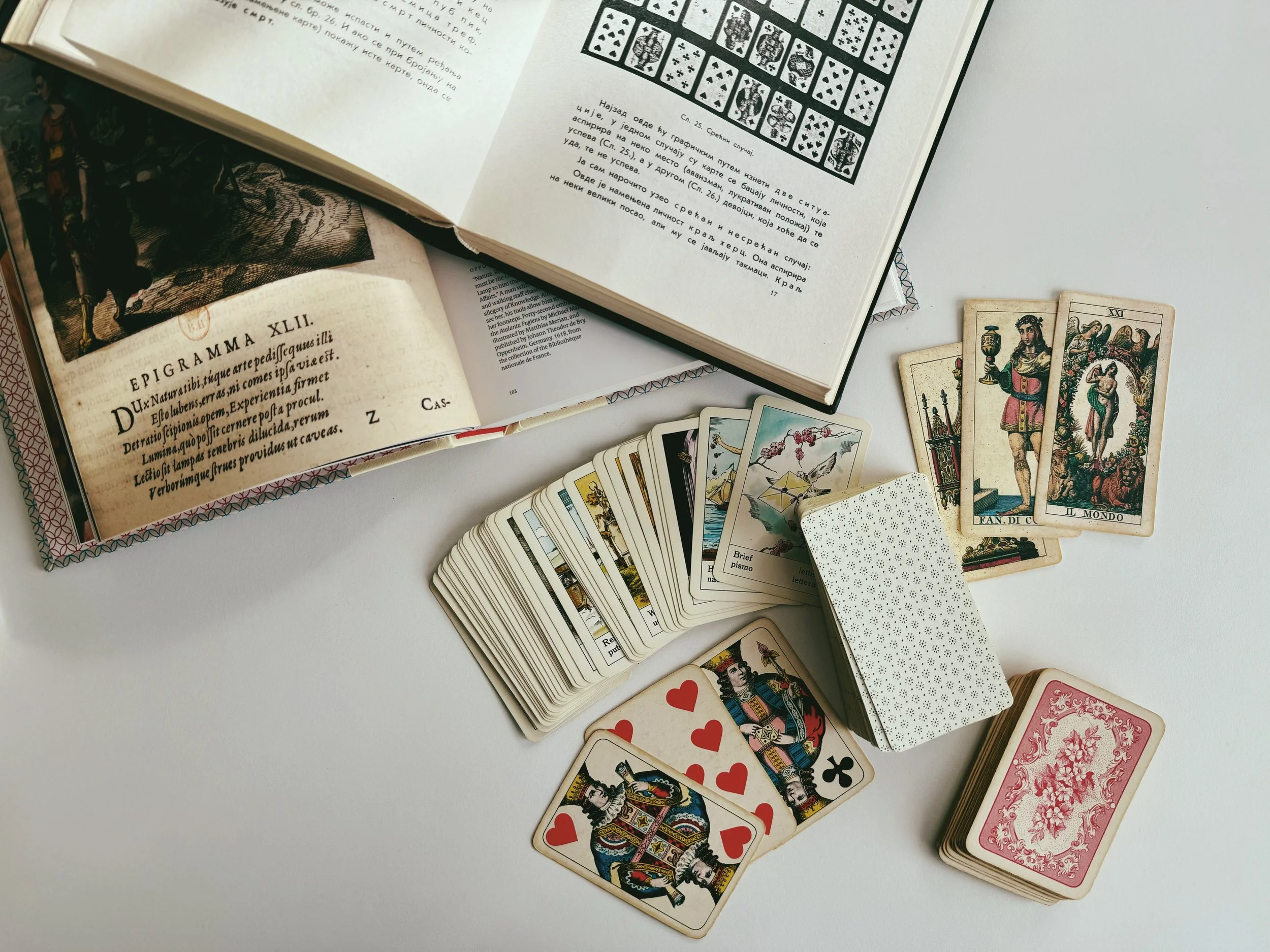
If this reading resonates with you, and if you are serious about developing precision in your work with the 32 playing cards, I want to invite you to my written course, Reading The 32 Playing Cards, available on my Lectures page. The course is built on exactly this foundation: not a list of meanings to memorize, but a living framework for reading that asks you to be present, to acknowledge what is there, and to follow the cards where they lead — even when they lead down.
Support the Free Blog
This blog will always remain free. If you find value in the writing and want to help me sustain the time and research that go into each article, you can make a contribution of your choice. It keeps the work independent, ad-free, and focused on substance rather than volume.